
The sacred Seruvila Rajamaha Viharaya is one of the most historic Buddhist temples located close to Trincomalee (Gokanna) in the Eastern Province of Sri Lanka. The place is also known as Seruwavila by the locals.
Seruvila can be reached via Kanthale or Trincomalee. The rout via Kanthale runs through the dense forest. It is only 40 km from Trincomalee via Muttur to Serwavila. The place can also be reached by sea. The sea rout starts at Trincomalee and ends at Muttur. From Muttur one has to take the land rout. The ancient visitors to Seruvila preferred the sea rout because it was a difficult journey on land through the dense forest infested with ferocious wild animals.
Seruvila/ Seruwavila:
Seru in Sinhalese is referred to a water bird belonging to the family of 'teals'. 'Vila' in Sinhalese means 'lake'. The region is a vast area of low land where the flood waters of the Mahaweli (the longest river in Sri Lanka) get collected. The lakes or rather the swamps in the area had been the home for large flocks of teals. Hence the area was known as 'seruvila' or 'Seruwavila'.

Seruvila Rajamaha Vihara is situated within the Mahaweli Delta. The Mahaweli ends its long arduous journey from the Eastern Province close to ancient Gokanna or as it is known today Trincomalee. Closer to the sea the Mahaweli gets divided into two. One of them falls into the sea from Verugal Aru at Lanka Patuna. The other ends its journey at Muttur. The hallowed precincts of Seruvila is snuggled in this Delta formed by the two rivers.
(Seruvavila )

(The Mahaweli Delta)
The Mixed Community in the area.
Seruvila is surrounded by Sinhala , Tamil and Muslim villages.
The Sinhala Villages:
Seruvilagama, Kavantissa Pura, Mahinda Pura , Seru Nuwara, Mahaweligama, Somapura, Siri Mangala Pura, Neelapola, Dehiwatta etc..
Tamil Villages:
Poonagar, Kiliweddi, Ichchalampattu, Verugal, Ilangathurei etc.
Muslim Villages:
Thoppur, Selvanagar etc

The presence of a large Tamil and Muslim population in the area was due to the South Indian invasions which destroyed the Buddhist cultural fabric and the prosperity of ancient Sri Lanka.
The scattered remains of ancient Buddhist monasteries and tanks which date back to thousands of years bear a formidable witness to the fact that the Eastern Province was the traditional homeland of the majority Sinhalese Buddhists.
However, with the frequent invasions and the mayhem caused by the invaders in the coastal areas the Sinhalese inhabitants were pushed towards the South or more interior parts of the country.
The South Indian invaders destroyed most of the Buddhist monasteries and everything that belonged to the Sinhalese. The same fate befell on the sacred Seruvila monastery, too and gradually it was subdued by the dense forest. The sacred Buddhist Stupa which enshrines the sacred 'forehead bone' (lalata datu) of the Gauthama Buddha went into oblivion from the Buddhists.
Though the place is clearly mentioned in the Datuwamsa: a book often read by the erudite Buddhists, only a few people showed an interest in discovering the ruined stupa hidden in the deep forest of Seruvila.
The most remarkable visit to the ruined stupa was made by Ven. Dambagasare Sri Sumedalankara Thero with a group of Buddhists in 1921. It was a turning point in the story of Seruvila Buddhist Temple. The historic visit paved the way for the Sri Lankan Buddhists to worship one of the most sacred places in the country. A part of Sri Lankan heritage which was on the brink of total destruction was revived and bestowed to the world.
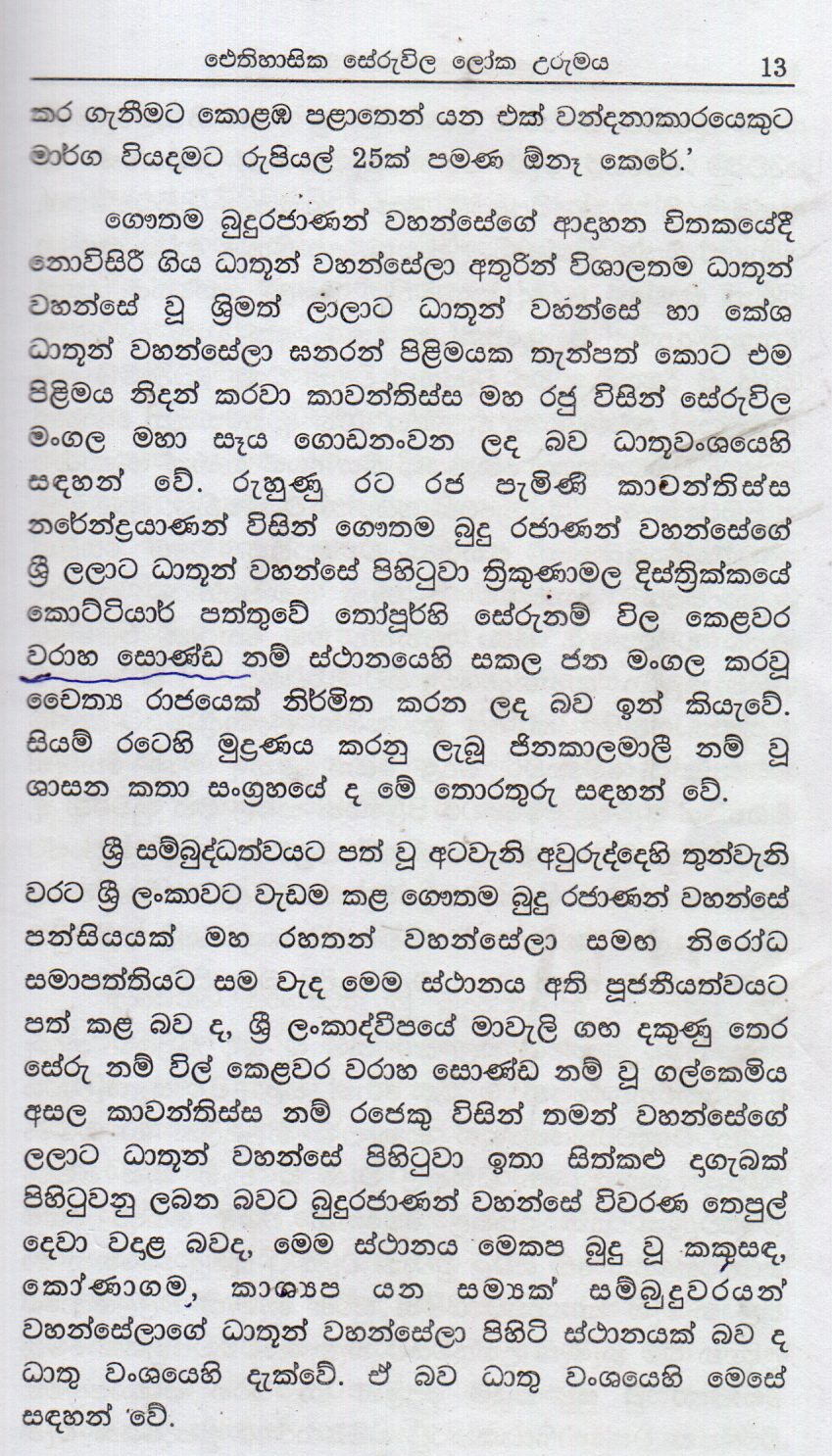
[ The details of the reconstruction of the Seruvila Raja Maha Vihara starting from 1921 are mentioned in detail in the book written by Lakshman Kahatapitiya titled 'Eithihasika Seruvila Loka Urumaya' which is availabe at the temple]

Ven. Dambagasare Sri Sumedalankara Thero
Though the place is clearly mentioned in the Datuwamsa: a book often read by the erudite Buddhists, only a few people showed an interest in discovering the ruined stupa hidden in the deep forest of Seruvila.
The most remarkable visit to the ruined stupa was made by Ven. Dambagasare Sri Sumedalankara Thero with a group of Buddhists in 1921. It was a turning point in the story of Seruvila Buddhist Temple. The historic visit paved the way for the Sri Lankan Buddhists to worship one of the most sacred places in the country. A part of Sri Lankan heritage which was on the brink of total destruction was revived and bestowed to the world.
[ The details of the reconstruction of the Seruvila Raja Maha Vihara starting from 1921 are mentioned in detail in the book written by Lakshman Kahatapitiya titled 'Eithihasika Seruvila Loka Urumaya' which is availabe at the temple]

Ven. Dambagasare Sri Sumedalankara Thero

( A picture depicting the historic visit to the ruined stupa by the Ven. thero and the starting the reconstruction work of the stupa)

It is believed according to the Datuwamsa that the place where the stupa has been constructed had also been the holy precincts where the relics of three other Buddhas namely Kakusanda, Konagama and Kassapa were kept and venerated. Besides this, it is believed that the Gauthama Buddha visited Seruvila on his third visit to Sri Lanka in the 8th year after enlightenment. There the Guathama Buddha had prophesied that 'a king by the name Kavantissa would build a magnificent stupa enshrined with lalata datu in a corner of the lake Seru besides the crop of rock named waraha Sonda upon the right bank of the river Mahaweli'.
⌛
King Kavantissa
According to the Datuwamsa the Seruvila Mangala Maha Seya was built by the great king Kavantissa. He was the king of Ruhuna at the time. King Kavantissa was also the father of the great king Dutugemunu. King Kavantissa married princess Viharamaha Devi whose father was Kelanitissa. It is believed that the king had enshrined in the stupa a gold image of the Gauthama Buddha with the relics of lalata datu: the forehead bone; the largest of the relics of the Buddha and some strands of sacred hair.




The history of the Seruvila Temple has been summed up through paintings in the image house.


The Separatist War in Sri Lanka and Seruvila:

The Seruvila temple was once again under threat with the start of the Tamil insurgency after 1982. This was not new for Seruvila because throughout the long history of Seruvila the region had constantly faced Cholla and Pandya invasions. When king Kavantissa constructed Seruvila Stupa enshrined with the sacred Lalata Datu the Northern part of Sri Lanka was ruled by Elara: a Tamil warrior king. The rule of Elara was terminated by King Kavantissa's own son, prince Dutugemunu.


